

Share this
by Mickey DeAngelo on Jan 29, 2026
What does it really take to create an efficient healthcare workforce across departments as different as critical care and environmental services?
The answer isn’t about imposing rigid uniformity. Instead, it hinges on a thoughtful approach to standardization that builds strong foundations, reduces unnecessary variation, and respects the unique needs of each clinical team.
When departments operate in silos, this creates confusion and inefficiency that can negatively impact staff and patient care. In my last post, I discussed why standardization is a strategic imperative for healthcare. When we move from the "why" to the "what," the true power of this approach is realized.
Applying standardization to specific processes allows us to eliminate unwarranted variation that serves neither the patient nor the staff. By focusing on key areas, organizations can unlock significant value and build a more resilient workforce.
The "Big 3" Core Processes
When we talk about workforce management, a few core processes have an outsized impact on an organization's health. Standardizing these "Big 3" is often the most challenging part of the journey, but it also yields the greatest rewards in equity, benchmarking, and agility.
1. Pay Practices and Policies
Over time, pay practices like shift differentials, callback rules, and overtime calculations often become a "wild west" of exceptions and special arrangements. This complexity not only makes payroll a nightmare but can also create deep-seated feelings of inequity among staff.
Standardizing these policies is a powerful move because it ensures that rules are applied fairly across the board, which is critical for employee trust. It also allows for accurate financial benchmarking. Sure, this can be politically charged, but it’s worth navigating since the benefits are immense.
One effective tip is to adjust rates to keep the financial impact neutral for employees.
Check out this video on how a healthcare organization we talked to is standardizing its processes after a recent change in its organizational structure.
2. Scheduling Processes
How schedules are built is fundamental to operational efficiency and employee satisfaction. When each unit manages its own siloed, paper-based schedule, it creates an imbalance between staff availability and patient demand.
We consistently hear from nursing leaders who are frustrated because they can't get a schedule published on time, preventing staff from being able to plan their lives.
Moving away from unit-based silos to a collaborative and transparent scheduling system can save frontline leaders up to several hours of administrative time per week. Using technology to carve out more time allows leaders to step away from paperwork and focus on mentoring their teams and improving clinical excellence.
3. Staffing Practices
Staffing is the art of making sure the right person with the right skills is in the right place at the right time. Without a standard language, workflow, and responsibility matrix for addressing resource needs, staffing becomes a reactive, costly scramble.
When staffing practices are standardized, healthcare systems can engage in evidence-based, data-driven planning. This means that every unit is staffed appropriately to meet patient needs in the most cost-effective manner. Over time, this shifts an organization from moving from constant crisis management to strategic resource allocation.
High-Value Strategic Standardizations
Beyond the core processes, certain strategic areas offer tremendous value when standardized. These initiatives often require a more sophisticated approach but can transform an organization's clinical and financial performance.
- Patient Acuity & Demand Forecasting: Moving from simple "census-based" staffing (heads in beds) to a more dynamic, acuity-based model is a game-changer. Using a validated, enterprise-wide classification system is essential for guaranteeing that the right skill mix is present to prevent missed nursing care and improve patient outcomes.
- Internal Float Pool & Contingent Labor Usage: How and when you flex your labor is a primary driver of financial stewardship. Standardizing the process for tapping into internal float pools before turning to high-cost agency staff is critical. It shouldn’t be up to an individual unit manager to decide to bring in an agency nurse. A standardized policy drives significant cost savings. In fact, one system I worked with saved $2.5 million in just eight months.
The Culture Builders
Finally, some processes might seem minor, but standardizing them has a major impact on organizational culture, fairness, and collaboration.
- Attendance & PRN Requirements: When requirements for "as-needed" (PRN) staff vary by department, it creates internal competition for the "easier" units and erodes the perception of fairness. Attendance ensures staffing levels remain predictable and ensures patients receive consistent, high-quality care. Standardizing these policies ensures consistency and reinforces a unified culture.
- Communication Protocols (Staffing Huddles): Standardizing the rhythm of work, such as implementing mandatory daily staffing huddles, breaks down departmental silos. These brief, structured check-ins ensure everyone is aligned on priorities, from patient needs to staffing challenges, fostering a collaborative environment that cascades from the front line to the C-suite.
Where Standardization Adds the Most Value
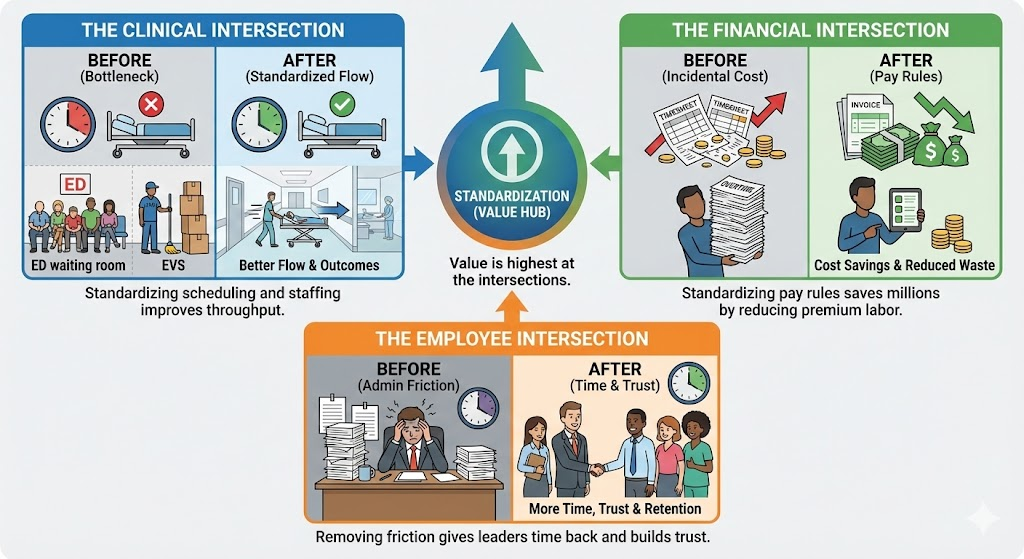
The value of standardization is highest at the intersections where different aspects of the organization meet.
- The Clinical Intersection: Standardizing scheduling and staffing has a direct correlation with patient outcomes and throughput. For example, when a patient in the ED is waiting for a room upstairs, the bottleneck might not be a nurse, but the EVS staff needed to turn the room. A holistic approach impacts the entire patient journey.
- The Financial Intersection: Standardizing pay rules and contingent labor policies can save millions by reducing "incidental" overtime and premium labor spend. It's one of the biggest opportunities health systems have to improve their bottom line by simply enforcing the rules they already have.
- The Employee Intersection: Removing the administrative friction from scheduling and pay gives leaders back their time and reduces a key driver of burnout. For staff, it provides the transparency and equity needed to build trust and improve retention.
Health systems can build a workforce management program that is not only efficient but also equitable and resilient once they begin standardizing these core, strategic, and cultural processes.
Turning theory into practice begins with the resources you integrate into your daily operations. Tools like Andgo’s automated shift-filling technology are pivotal in streamlining staffing processes that lead to improved outcomes for both staff and patients.
Curious to learn more about how Andgo’s solutions can make staffing standardization a reality for your workforce?